Entries by Aksel Kibar

GLOBAL EQUITY MARKETS – March 10, 2018

REVIEW


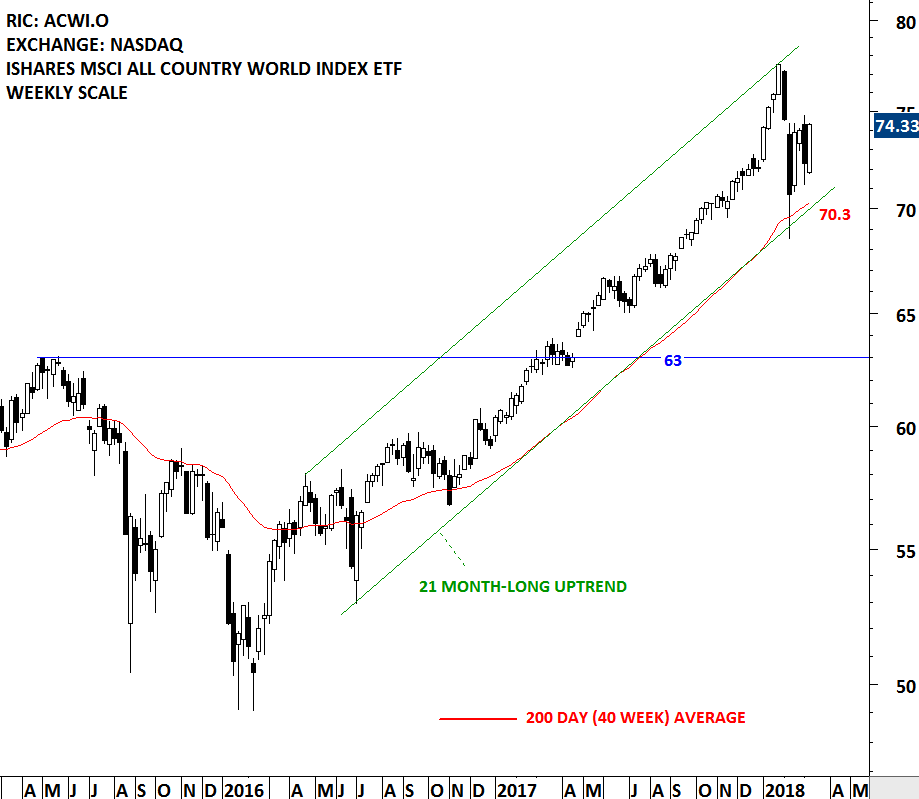
A strong weekly close and especially a strong Friday price action is positive for Global equities. However, it is still early to conclude that the short term consolidation is over and we are headed to new all-time highs. I think we are still in the consolidation phase and choppy price action can continue for some time.

The long-term trend is upwards for the iShares MSCI All Country World Index ETF (ACWI.O). The benchmark for Global equity market performance continues to remain above its long-term average. In the short/medium-term, the ETF is in a trading range between the all-time high at 77.55 and 70 levels.

Read More

INTERIM UPDATE – March 7, 2018

Reminder on Live Webinar

Due to very positive feedback we got for the last webinar on rectangle chart patterns, we are continuing the webinar series with another reliable horizontal chart pattern; the ascending triangle. Live Webinar and Q&A with Aksel - Thursday, March 8, 11am mountain. You can register here (Register for the Live Webinar)

Over the past few weeks Global Equity Markets report featured some great chart setups in U.S. Regional Banks & Financials. Some of those chart patterns are resolved on the upside and some are about to complete. As we see more strength in the sector I thought it is a good time to review some of those recent chart pattern developments. Read More

GLOBAL EQUITY MARKETS – March 3, 2018

Reminder on Live Webinar

Due to very positive feedback we got for the last webinar on rectangle chart patterns, we are continuing the webinar series with another reliable horizontal chart pattern; the ascending triangle. Live Webinar and Q&A with Aksel - Thursday, March 8, 11am mountain. You can register here (Register for the Live Webinar)


REVIEW


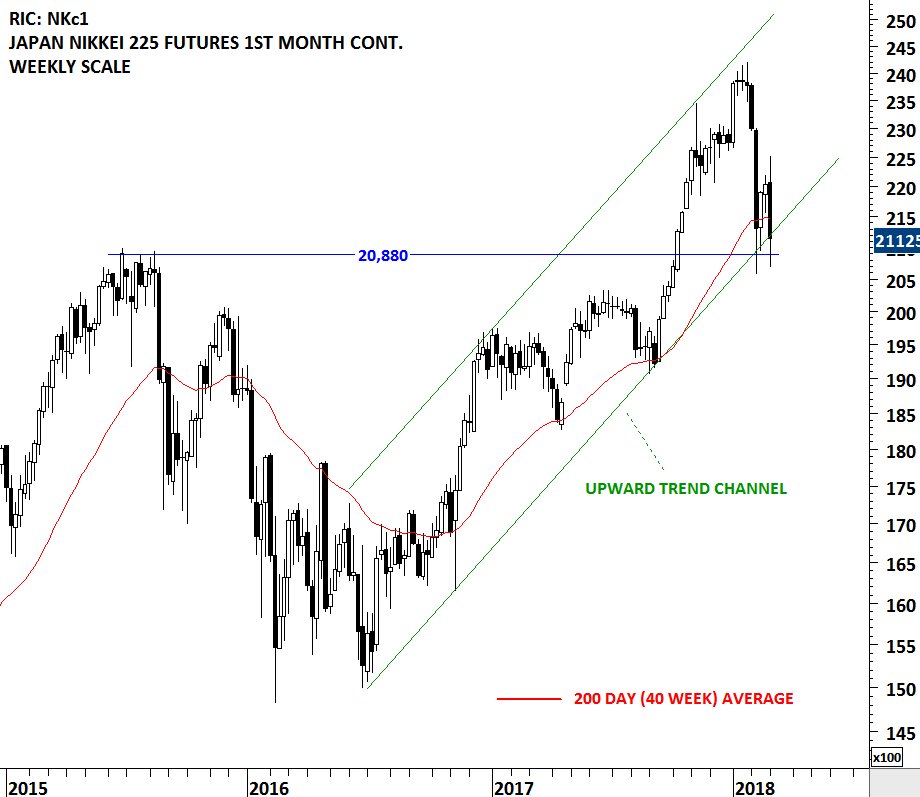
Equity indices that had weak rebound from the lows, tested the same support areas. Japan's Nikkei Index is one of them. On the weekly scale we can see that the upward trend channel is still intact with the support forming at 20,880 levels. On the daily scale price chart (futures price data to capture Friday's close) we can see that the Friday's recovery on U.S. indices helped the Nikkei Futures to form a Doji candlestick at the support. Failure to hold these levels can result in a larger scale correction. In the short-term Japan's Nikkei will try to find support around 20,880 levels and if it succeeds we will possibly label the price action as a double bottom.

Read More

ISHARES 20+ YEAR TREASURY BOND ETF

Every week Tech Charts Global Equity Markets report features some of the well-defined, mature classical chart patterns under a lengthy watchlist and the chart pattern breakout signals that took place during that week. Global Equity Markets report covers single stocks from developed and emerging markets, ETF’s and global equity indices. The report starts with a review section that highlights the important chart developments on global equity benchmarks. This blog post features one of several great chart analysis that were highlighted in the review section from the previous Global Equity Markets report.

Read More

GLOBAL EQUITY MARKETS – February 24, 2018

REVIEW


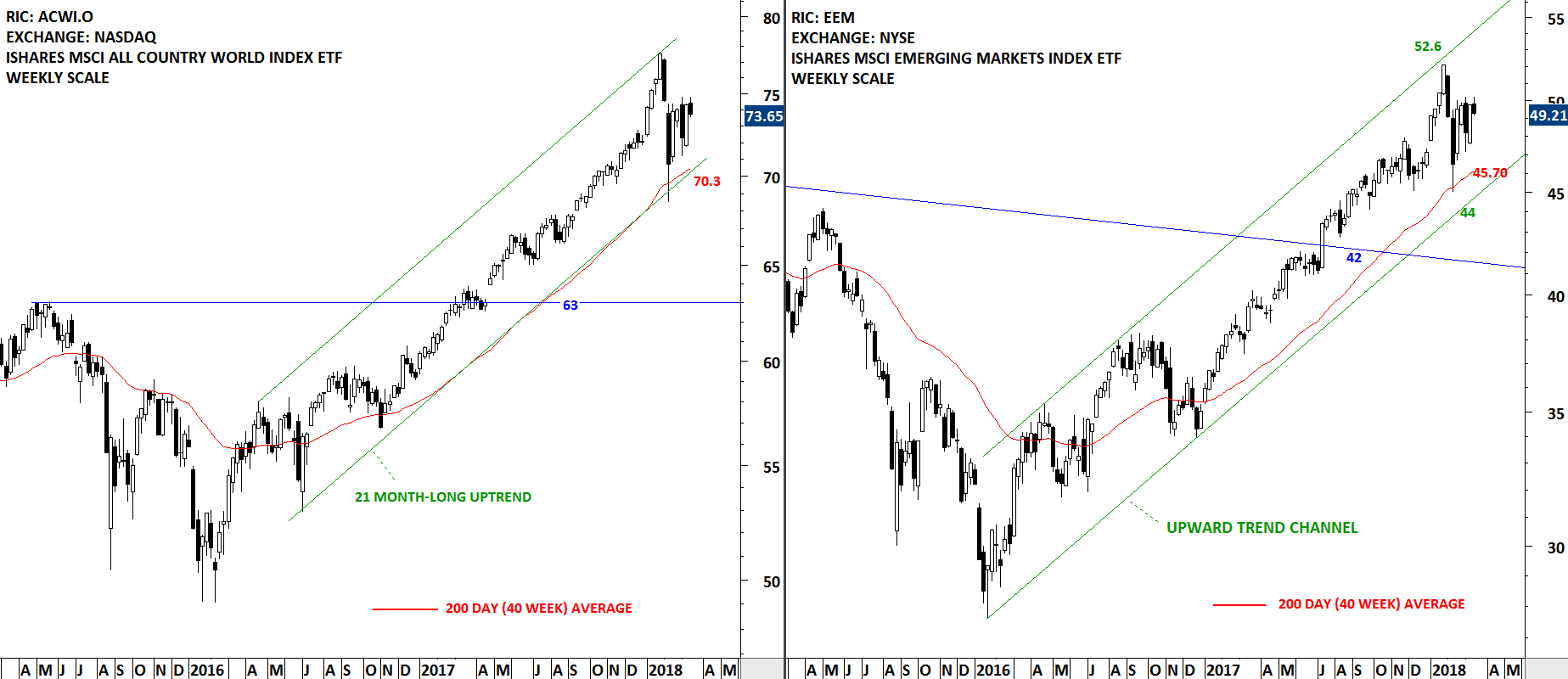
Global equity markets rebounded sharply and held on to last week's gains. I follow the iShares MSCI All Country World Index ETF (ACWI.O) as a benchmark for the Global equity markets performance. The ETF is in a steady uptrend above the long-term (200 day, 40 week) average. Volatility increased in the month of February after the sharp sell-off in the equity markets. The ACWI ETF tested its long-term average which is now acting as strong support at 70 levels. Choppy sideways price action can continue for some time until we see lower levels on volatility. Usually, markets go through a period of consolidation after sharp corrections. I think we are in that stage.

Read More

TOP DOWN vs. BOTTOM UP ANALYSIS

Bottom-up research & investing focuses on the individual stocks and deemphasizes the significance of economic cycles and market cycles. In bottom-up investing, the investor focuses his attention on a specific company, rather than on the industry in which that company operates or on the economy as a whole. This is the opposite of top-down research & investing, which is a strategy that first considers macroeconomic factors when making an investment decision. Top-down investors instead look at the broad performance of the economy, and then seek industries that are performing well, investing in the best opportunities within that industry.

Read More

GLOBAL EQUITY MARKETS – February 17, 2018

REVIEW


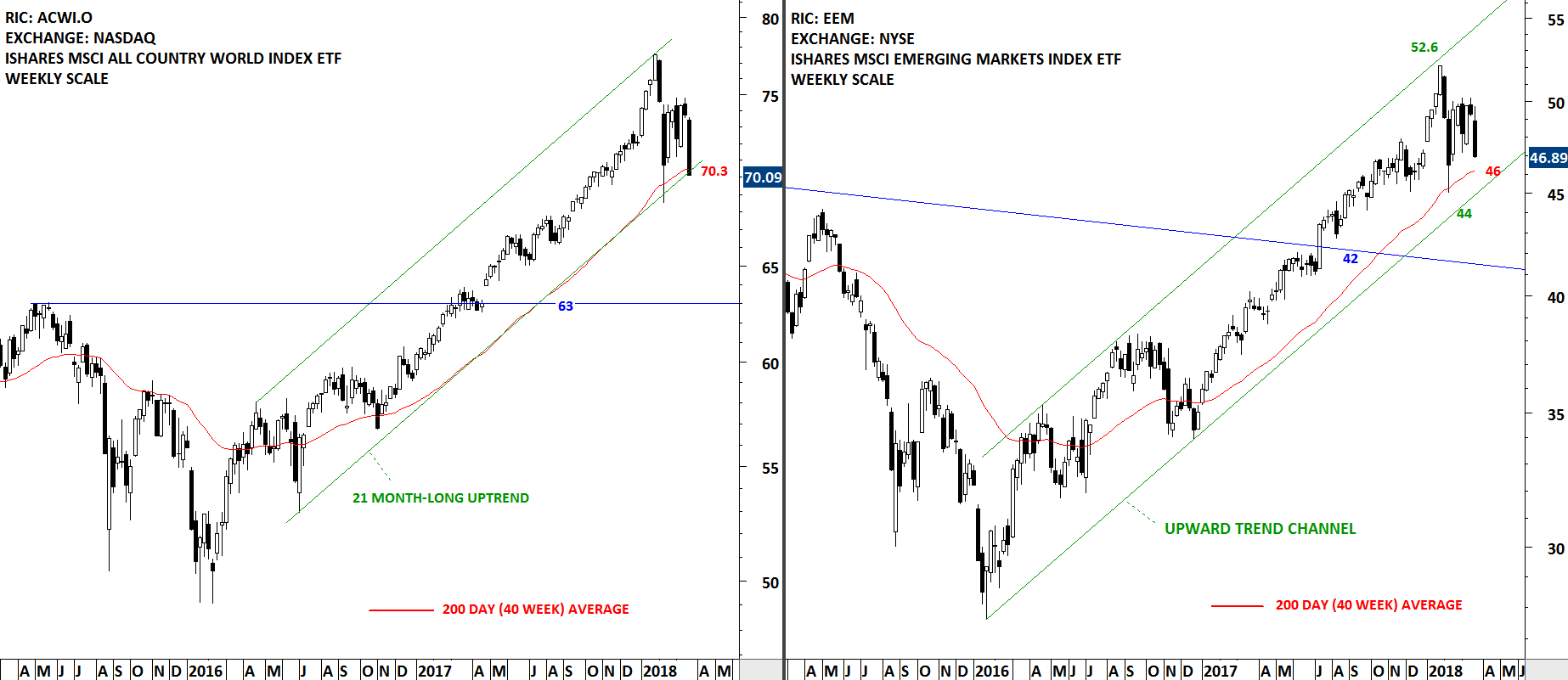
Global Equity Markets had a strong rebound from their long-term averages. A benchmark for Global equity market performance; the iShares MSCI All Country World Index ETF rebounded from its 200-day (40 week) average and the lower boundary of its multi-month long upward trend channel. Long-term uptrend remains intact. In the following weeks Global equity indices will possibly continue to consolidate in a range until volatility is back to lower levels. In case of a re-test of last week's lows, both the lower boundary of the uptrend and the long-term average will act as strong support levels.

Read More

RECTANGLE – TRADING RANGE

A stock (ETF, Index etc.) price is either in a trending phase or in a consolidation period. During strong trend periods prices move uninterrupted from one price level to another. During consolidations prices move in both directions without producing any meaningful or sustained price change and will form well-defined support and resistance areas on the charts. A support range represents a concentration of demand, and a resistance range represents a concentration of supply.

A resistance level is an approximate level or fairly well-defined price range, where previously advancing stock meets resistance in the form of strong selling. A support level is an approximate level or price range where a preceding decline meets support, in the form of strong buying. A possible explanation for appearance of such well-defined price boundaries in the form of support and resistance can be the fact that the public tend to remember previous levels the stock has traded.

The longer the time which the stock spent in that range, therefore, the greater the number of transactions, the more important that range becomes for future technical consideration. In applying support and resistance study to price charts, the weekly scale time frame is usually more informative than daily scale. Weekly charts show much more plainly the levels at which congestion of significant duration appeared.

Read More

GLOBAL EQUITY MARKETS – February 10, 2018

REVIEW


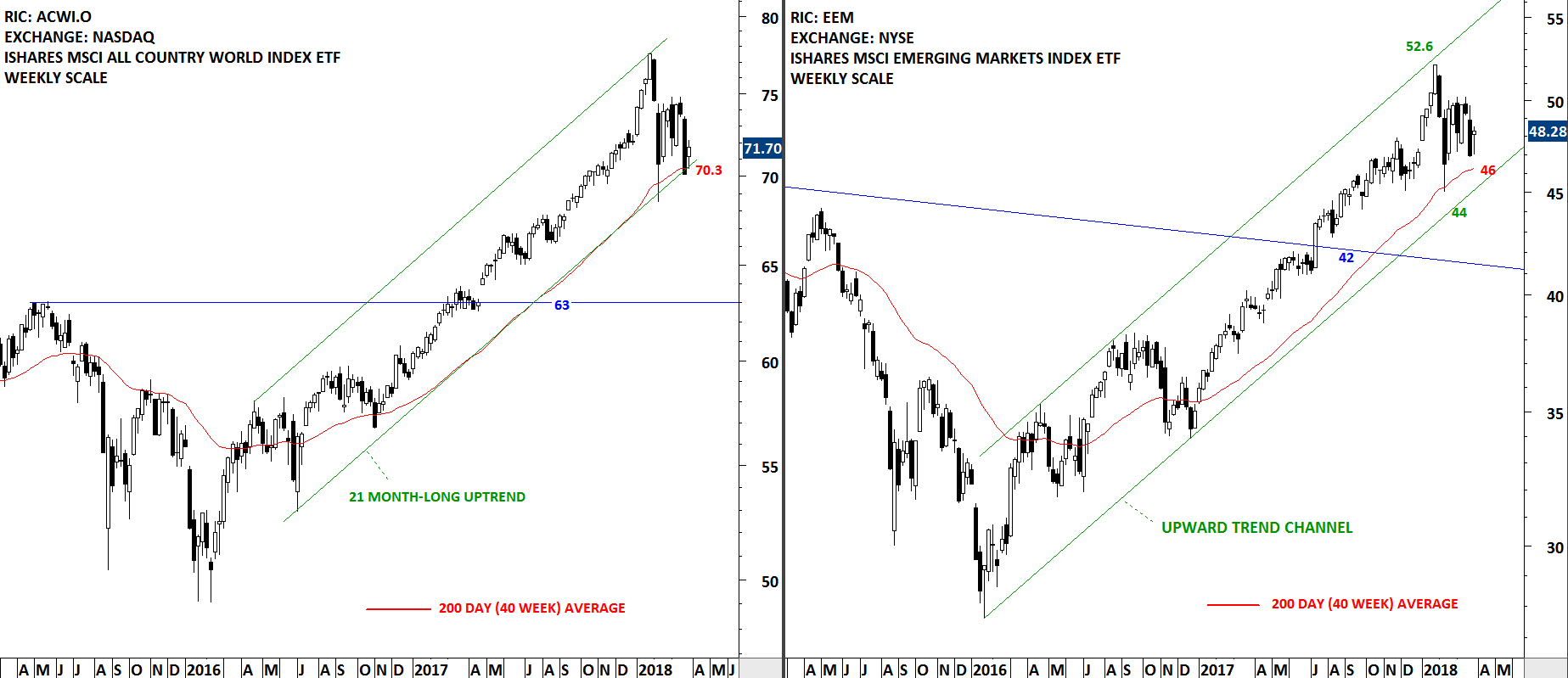
Global equity benchmarks deviated far from the averages that a 10% correction in 2 weeks is still considered a reversion to the mean. With this week's continued sell-off both benchmarks for Global equities, the iShares MSCI All Country World Index ETF and the iShares MSCI Emerging Markets Index ETF reached their respective 200-day (40 week) moving averages. The 200-day moving average and the lower boundary of multi-month long upward trend channels are forming support around the same levels. Read More

INTERIM UPDATE – February 9, 2018

PREMATURE & FALSE BREAKOUTS

Below two paragraphs are taken from Peter L. Brandt’s Diary of a Professional Commodity Trader – Lessons from 21 weeks of real trading.

premature breakout is different from an out of line movement in the sense that a premature breakout can close outside of a predrawn boundary line and even spend several days in breakout mode. Prices then return back to the geometric pattern. However, the initial breakout was only a harbinger of things to come, and within a few weeks a genuine breakout occurs. I call these subsequent breakouts secondary breakouts or pattern recompletions.” – Ch 3, page 38, Identifying the trades and the trading vocabulary

Read More