
GLOBAL EQUITY MARKETS – April 25, 2020
/2 Comments/in Premium/by Aksel KibarREVIEW
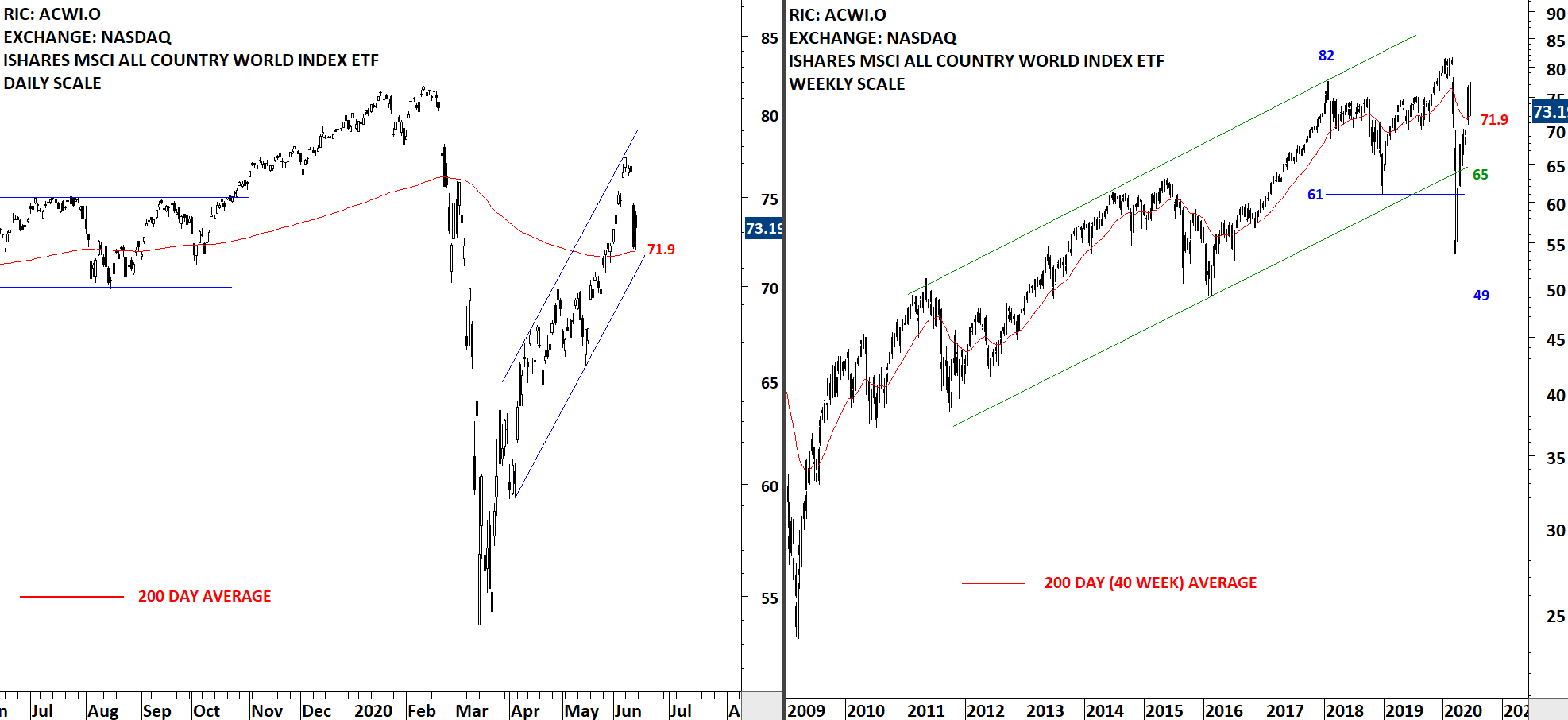
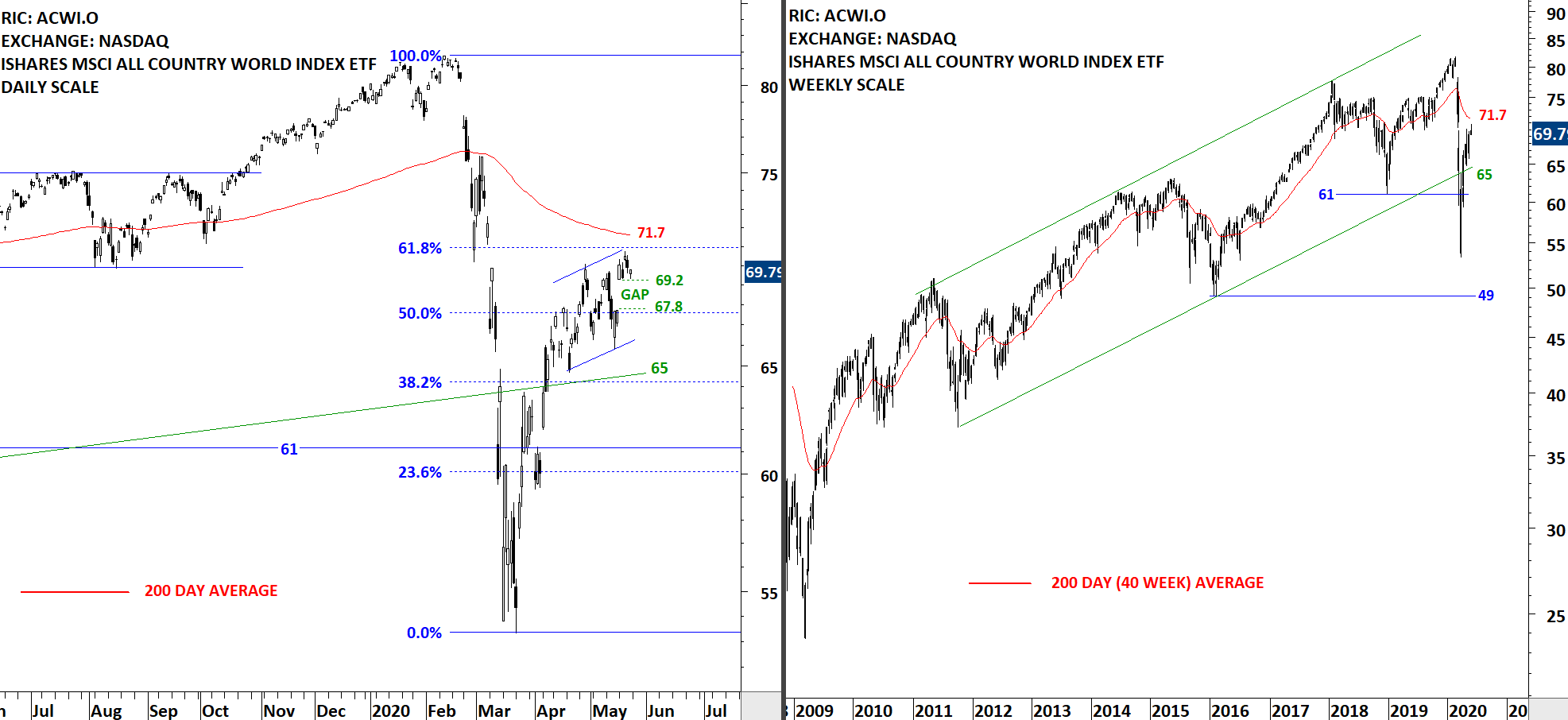
The benchmark for the Global equity markets performance, the iShares MSCI All Country World Index ETF (ACWI.O) continued to hold on to its gains after its rebound that started in Mid-March. From the lows, the ETF recovered 50% of the decline that started in February. The 200-day moving average is far from the price at 72.3 levels. There is no clear chart pattern development on daily and weekly scale price charts. The ETF is in a downtrend below the 200-day average.
Read MoreGLOBAL EQUITY MARKETS – April 18, 2020
/7 Comments/in Premium/by Aksel KibarREVIEW
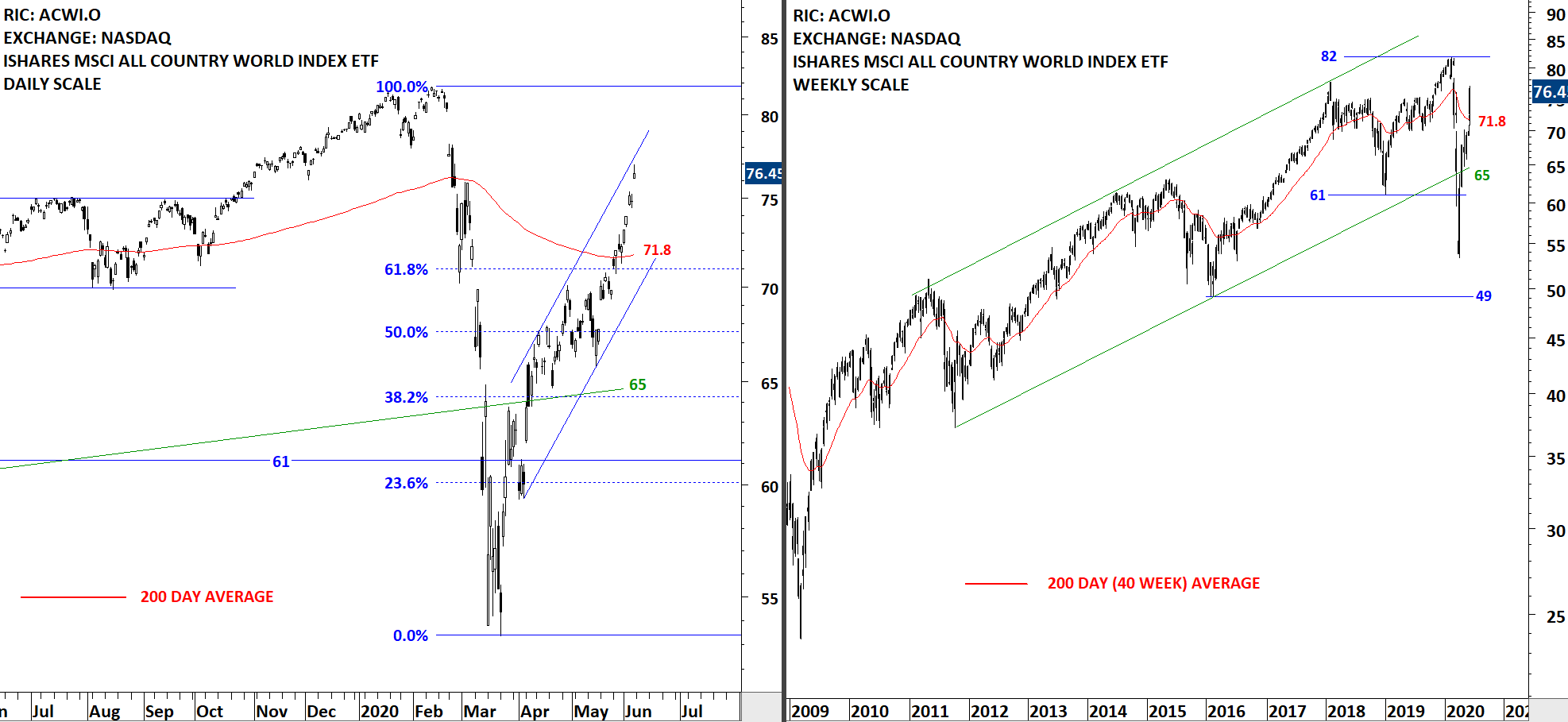
The benchmark for the Global equity markets performance, the iShares MSCI All Country World Index ETF (ACWI.O) recovered above the lower boundary of a possible upward trend channel at 64 levels. Support area between 61-64 area was broken down and now price is above this area. From the lows, the ETF recovered 50% of the decline that started in February. The 200-day moving average is far from the price at 72.6 levels. There is no clear chart pattern development on daily and weekly scale price charts. The ETF is in a downtrend below the 200-day average.
Read MoreGLOBAL EQUITY MARKETS – April 11, 2020
/10 Comments/in Premium/by Aksel KibarREVIEW
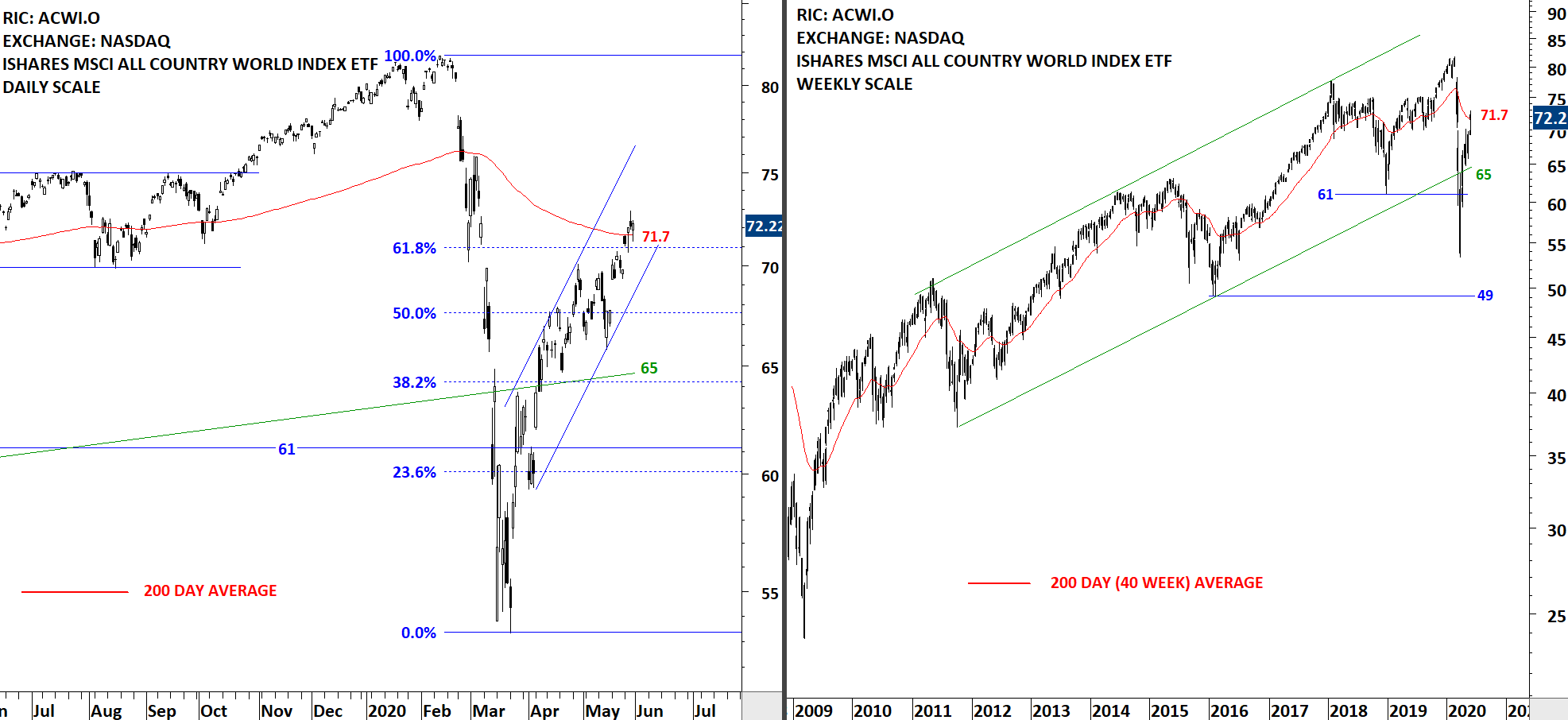
The benchmark for the Global equity markets performance, the iShares MSCI All Country World Index ETF (ACWI.O) recovered above the lower boundary of a possible upward trend channel at 64 levels. Support area between 61-64 area was broken down and now price is above this area. From the lows, the ETF recovered 50% of the decline that started in February. The 200-day moving average is far from the price at 72.9 levels. There is no clear chart pattern development on daily and weekly scale price charts. The ETF is in a downtrend below the 200-day average.
Read MoreGLOBAL EQUITY MARKETS – April 4, 2020
/3 Comments/in Premium/by Aksel KibarREVIEW
The benchmark for the Global equity markets performance, the iShares MSCI All Country World Index ETF (ACWI.O) found resistance at 64 levels, the lower boundary of a possible upward trend channel. Support area between 61-64 area was broken down and now it is acting as resistance during the rebound. The minor low of 2016 stands as the next support at 49 levels. I will continue to monitor short-term price charts for a possible bottom reversal chart pattern. Patterns I'm looking for are double bottom, rectangle and H&S bottom. A re-test of the lows or another down leg to test 49 levels can offer a short/medium-term bottom opportunity. There is a gap opening between 55.5 and 57.2 levels. I will monitor next week, if any weakness develops, the GAP area as a possible support.
Read More4 Types of Breakouts – March 2020 Tech Charts Webinar
/0 Comments/in Member Webinars, Premium/by Aksel Kibar4 Types of Breakouts - March 2020 Tech Charts Webinar
We are continuing our Member webinar series with a review of 4 types of breakouts.
Type 1 are breakouts that immediately rally to price target. Type 2 are breakouts that pullback to chart pattern boundary after the breakout but do not challenge the previously broken support/resistance. These two breakouts are relatively easier to manage when compared with the breakouts that experience a hard re-test (penetrating the chart pattern boundary after a breakout) and those that fail (Type 3 & Type 4).
We will review all 4 types of breakouts with recent examples and discuss strategies to manage each condition.
Webinar Outline- We will review some of those chart pattern breakouts that rally to their price objective without any pullback
- We will review some of the breakouts that complete an orderly pullback to chart pattern boundary
- We will look at some of the breakouts that experience hard re-test and challenge chart pattern boundaries
- We will review some of the breakouts that failed off of the starting gate.
- We will have a member Q&A at the end of the webinar.
- I know you're a classical market technician, but with such a severe one-sided breakdown, are you ever tempted to trade something for a pullback even though you don't have a classical pattern? 36:21
- Does the speed with which a pattern breakout achieves the target price indicate that you should let the trade run? 37:24
- Can you find signs in the chart that could indicate what type of breakout is going to occur? 38:02
- Do you reduce your position sizing (i.e., instead of 1% risk per trade, 0.50% risk) during extended volatility like we're seeing? 39:42
- Can you explain how to calculate the trailing stop loss again? 40:10
- Additional links ATR Trailing Stop-Loss – H&S Top & ATR plug-in
- How do you incorporate sentiment measures (COT DSI etc.) into your decision making? 40:48
- Do you think that in market conditions such as these, the probability of a failed chart occurring is higher? 41:02
- Do you ever circumvent your ATR trailing stop and place it below a newly formed chart pattern negation level that's above the initial entry position? 42:32
- I noticed that on one trade, you placed an SL at the bottom of a gap, but on another, you placed it at the top of a GAP. Do you have rules for deciding this? 43:50
- Is it possible to use this method for long term investing? If yes, would you use the same trailing method? 45:13
- Can the ATR stop rule be implemented in a trading platform? 46:19
- How do you determine your ATR length and multiplier number? Is it historical chart based and specific to a specific chart? Are commodities different than stock charts? 47:13
- As volatility during the day can be larger, have you used one ATR multiple for intra-bar & a lesser ATR multiple near the close, whereby one cancels the other OCO? 49:20
- Over the years, the ratio between reversal patterns vs. continuation patterns? Do you cap that ratio, or you let the patterns dictate what you have currently? 50:08
- Do you always trade long? Never short? 51:13
GLOBAL EQUITY MARKETS – March 28, 2020
/0 Comments/in Premium/by Aksel KibarREVIEW
The benchmark for the Global equity markets performance, the iShares MSCI All Country World Index ETF (ACWI.O) had a sharp rebound. 61 levels was the low that was recorded in late 2018. 64 levels is the lower boundary of a possible upward trend channel. Support area between 61-64 area was broken down and now it is acting as resistance during the rebound. The minor low of 2016 stands as the next support at 49 levels. I will continue to monitor short-term price charts for a possible bottom reversal chart pattern. Patterns I'm looking for are double bottom, rectangle and H&S bottom. A re-test of the lows or another down leg to test 49 levels can offer a short/medium-term bottom opportunity.
Read MoreLive Webinar and Q&A with Aksel – Thursday, March 26, 8:30 am mountain
/0 Comments/in Premium/by Jolleen OlesonDear Tech Charts Members,
We are continuing our Member webinar series with a review of 4 types of breakouts. Type 1 are breakouts that immediately rally to price target. Type 2 are breakouts that pullback to chart pattern boundary after the breakout but do not challenge the previously broken support/resistance. These two breakouts are relatively easier to manage when compared with the breakouts that experience a hard re-test (penetrating the chart pattern boundary after a breakout) and those that fail (Type 3 & Type 4).
We will review all 4 types of breakouts with recent examples and discuss strategies to manage each condition.
Scheduled for: Thursday, March 26th, 8:30 am mountain (register below)
Read MoreGLOBAL EQUITY MARKETS – March 21, 2020
/0 Comments/in Premium/by Aksel KibarREVIEW
The benchmark for the Global equity markets performance, the iShares MSCI All Country World Index ETF (ACWI.O) after testing its 200-day average for a very short period, resumed its downtrend. Sharp sell-offs can be followed by sharp rebounds. It is important where the next consolidation is going to take place. So far the ETF experienced sharp sell-off with out any rebound. Support area between 61-64 area is broken down and will act as resistance during any rebound. The minor low of 2016 stands as the next support at 49 levels. I will continue to monitor short-term price charts for a possible bottom reversal chart pattern. Patterns I'm looking for are double bottom, rectangle and H&S bottom.
Read MoreGLOBAL EQUITY MARKETS – March 14, 2020
/3 Comments/in Premium/by Aksel KibarREVIEW
The benchmark for the Global equity markets performance, the iShares MSCI All Country World Index ETF (ACWI.O) after testing its 200-day average for a very short period, resumed its downtrend. Sharp sell-offs can be followed by sharp rebounds. It is important where the next consolidation is going to take place. Price clearly is settling below the 200-day average. The sell-off in 2018 reversed from 61 levels. This week the ETF tested 61 levels and rebounded. 61-64 area is also a support formed by the lower boundary of a possible uptrend channel. Here are the questions I'm looking answers for in the coming weeks: Will the markets find a bottom here? If yes, are we going to see some sort of bottom reversal chart patterns on short-term price charts? A double bottom, a rectangle reversal, a H&S bottom? Is there a possibility of a V-reversal bottom similar to 2018? A V-reversal bottom will be the most difficult to analyze and profit from. In that case I will turn to individual stocks to find orderly consolidations for breakout opportunities.
Read MoreIn Association with:
Latest Posts
BREAKOUT ROOM February 1, 2026 – LIVE MEETING, CHARTS Q&A (Recording)February 4, 2026 - 2:38 pm
GLOBAL EQUITY MARKETS – January 31, 2026January 31, 2026 - 11:25 am
BREAKOUT ROOM SUNDAY 1st of February 9:00 AM EST – LIVE MEETING, CHARTS Q&AJanuary 30, 2026 - 5:34 am
INTERIM UPDATE – January 29, 2026January 29, 2026 - 7:15 pm
Search
As Seen On: